
Prototyping is a critical stage in product development that provides in-depth, real-world testing before moving to the next stage of product design. The prototyping phase covers every step between initial ideation and mass production, and each prototyping and engineering journey is unique.
There are two core aspects to prototyping and engineering:
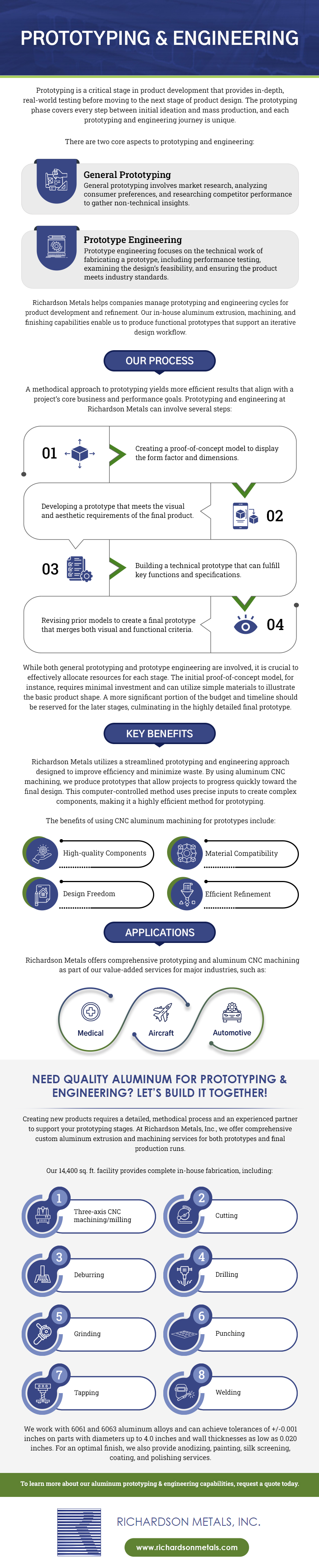
- General prototyping. General prototyping involves market research, analyzing consumer preferences, and researching competitor performance to gather non-technical insights.
- Prototype engineering. Prototype engineering focuses on the technical work of fabricating a prototype, including performance testing, examining the design’s feasibility, and ensuring the product meets industry standards.
Richardson Metals helps companies manage prototyping and engineering cycles for product development and refinement. Our in-house aluminum extrusion, machining, and finishing capabilities enable us to produce functional prototypes that support an iterative design workflow.
Our Process
A methodical approach to prototyping yields more efficient results that align with a project’s core business and performance goals. Prototyping and engineering at Richardson Metals can involve several steps:
- Creating a proof-of-concept model to display the form factor and dimensions.
- Developing a prototype that meets the visual and aesthetic requirements of the final product.
- Building a technical prototype that can fulfill key functions and specifications.
- Revising prior models to create a final prototype that merges both visual and functional criteria.
While both general prototyping and prototype engineering are involved, it is crucial to effectively allocate resources for each stage. The initial proof-of-concept model, for instance, requires minimal investment and can utilize simple materials to illustrate the basic product shape. A more significant portion of the budget and timeline should be reserved for the later stages, culminating in the highly detailed final prototype.
Key Benefits
Richardson Metals utilizes a streamlined prototyping and engineering approach designed to improve efficiency and minimize waste. By using aluminum CNC machining, we produce prototypes that allow projects to progress quickly toward the final design. This computer-controlled method uses precise inputs to create complex components, making it a highly efficient method for prototyping.
The benefits of using CNC aluminum machining for prototypes include:
- High-quality components. Produces parts with excellent physical attributes and surface finishes suitable for both looks-like and works-like prototypes.
- Material compatibility. CNC machining is highly compatible with a wide range of aluminum alloys.
- Design freedom. Brings complex designs to life quickly without the need for costly tooling.
- Efficient refinement. Can make alterations between prototypes with minimal impact on lead times.
Applications
Richardson Metals offers comprehensive prototyping and aluminum CNC machining as part of our value-added services for major industries, such as:
Medical
Aluminum machining produces accurate, clean, and biocompatible prototypes. This allows companies in the medical field to test the validity of new surgical instruments, orthopedic tools, and general-purpose medical equipment like trays and containers. After the prototyping stage, these medical products can be mass-produced using the same high-quality aluminum alloys.
Aircraft
Aerospace components must withstand extreme conditions without adding excess weight. Aluminum offers an excellent strength-to-weight ratio, corrosion resistance, and machinability. Aircraft companies can use aluminum parts for both test runs and final aircraft assemblies.
Automotive
Automotive manufacturers increasingly use aluminum for components like wheels, transmission bodies, engine cylinder blocks, and radiators. A lightweight metal, aluminum improves fuel efficiency without sacrificing strength or durability. With tailored services and support from Richardson Metals, manufacturers can engineer durable, high-performance vehicle parts.
Need Quality Aluminum for Prototyping & Engineering? Let’s Build It Together!
Creating new products requires a detailed, methodical process and an experienced partner to support your prototyping stages. At Richardson Metals, Inc., we offer comprehensive custom aluminum extrusion and machining services for both prototypes and final production runs.
Our 14,400 sq. ft. facility provides complete in-house fabrication, including:
- Three-axis CNC machining/milling
- Cutting
- Deburring
- Drilling
- Grinding
- Punching
- Tapping
- Welding
We work with 6061 and 6063 aluminum alloys and can achieve tolerances of +/-0.001 inches on parts with diameters up to 4.0 inches and wall thicknesses as low as 0.020 inches. For an optimal finish, we also provide anodizing, painting, silk screening, coating, and polishing services.
To learn more about our aluminum prototyping & engineering capabilities, request a quote today.